Understand the result · 4 min read
How our AI detection works
How we aim to replicate Turnitin’s AI scoring, so you can preview your likely result and submit with more confidence.
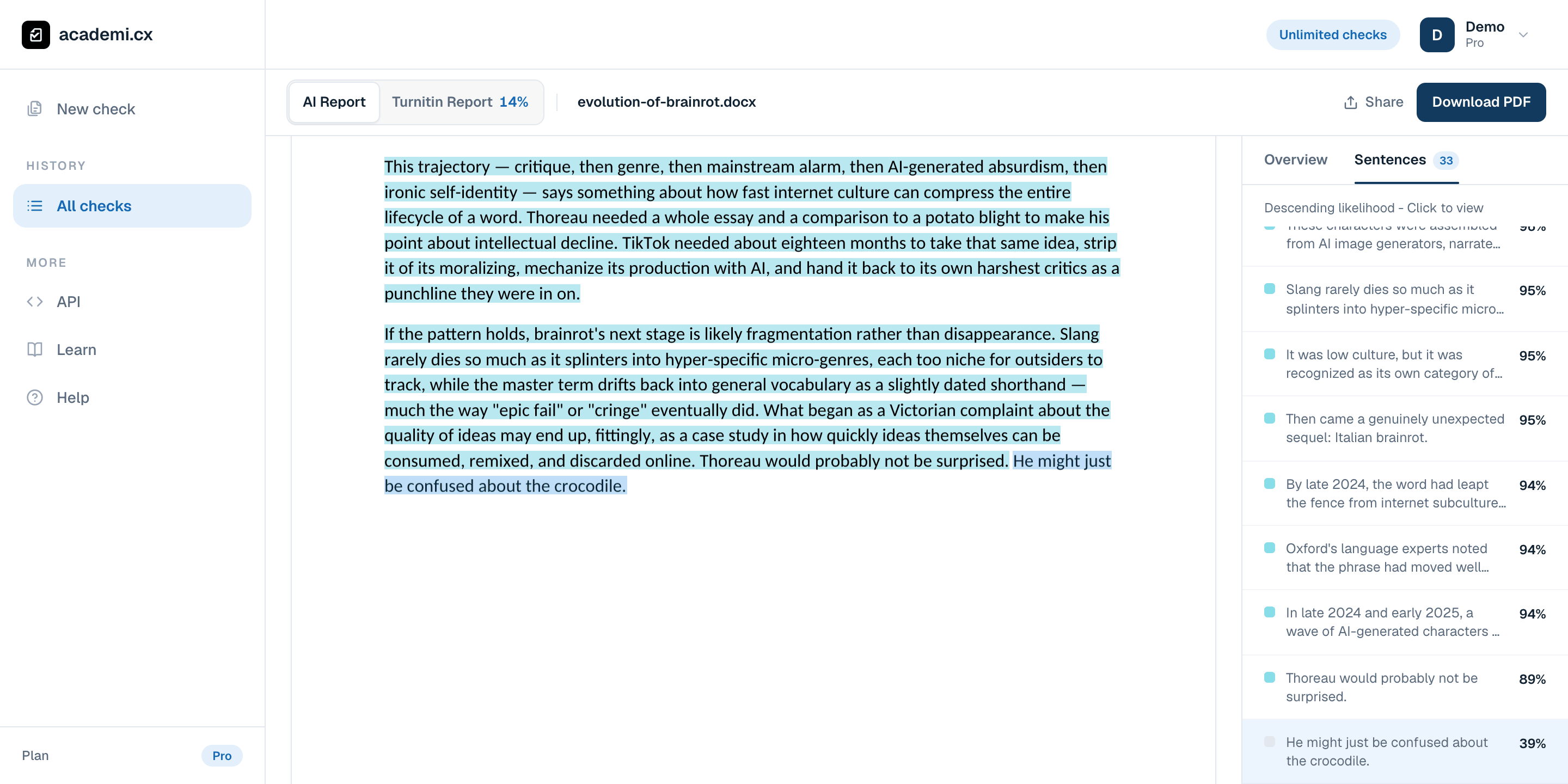
The unlocked sentence list puts stronger AI signals first. These numbers help you decide where to look; averaging them does not reproduce the overall score.
Preview your Turnitin AI score before you submit
Our goal is to replicate Turnitin’s AI scoring as closely as possible. You should be able to check a draft, see the score and passages Turnitin is likely to flag, and understand what to expect before submitting your work. That gives you time to review unexpected results and make informed changes, with more confidence about what comes next.
We judge our model by how closely its results agree with Turnitin on the same writing. That includes both the overall AI percentage and which sentences are flagged. These comparisons measure agreement with Turnitin; they do not independently establish who wrote a passage. Our benchmark lets you inspect those comparisons.
The AI report is our prediction of Turnitin’s result, so an exact match on every submission is not guaranteed. It gives you an advance view of the likely outcome; the final Turnitin score may differ.
How we trained it
Starting with a language model, we fine-tuned it for a specific job: predicting how Turnitin would classify a sentence.
Think of it as practice with feedback. We paired writing with labels taken from millions of Turnitin’s own report highlights: which sentences it flagged and which it did not. Our model then made predictions, we compared them with those labels, and training adjusted the model to reduce the differences. After learning from a broader set of reports, it received further fine-tuning focused on the current version of Turnitin’s detector, ensuring consistent accuracy across Turnitin updates.
We also set aside reports that the model never trained on. Checking its progress against those examples helped us select a version that performed well on writing outside its practice material. Testing our model on “seen” examples alone is not accurate and would produce overconfident results; the aim during testing is to find out whether our model learned how to accurately classify Turnitin text.
How length and context affect results
In our testing, longer documents generally produced results that agreed more closely with Turnitin. Surrounding sentences give the classifier more context, and each individual sentence usually represents a smaller share of the document. A complete draft gives it more to work with than a short extract.
On a short document, even one missed sentence can make a noticeable difference. For a simple example, one missed sentence out of ten equally sized sentences changes the share of flagged text by 10 percentage points. The exact change in the reported score varies with the document, but this explains how a small disagreement can produce a large gap between the percentages.
The pattern has limits. Very short and very long documents tended to show more discrepancies with Turnitin in our testing. More length does not guarantee a closer match. Use a complete, relevant draft within the supported limits, and compare the highlighted passages as well as the headline percentage.
Context can also pull a sentence’s assessment toward the pattern in the surrounding writing. When a draft mixes different writing styles or sources, read the individual sentence alongside its paragraph before drawing a conclusion.
- Check a complete draft or a coherent section whenever possible.
- Keep the surrounding sentences, rather than testing a few words in isolation.
- Use relevant context. Adding unrelated text does not make a check more trustworthy.
Scoring Steps:
The checker reads the document, identifies the prose it can assess, and scores its passages. References and other excluded material do not count as ordinary prose. The report then brings the result back to your document with highlights and a summary.
Start with the overall percentage for a preview of your likely Turnitin AI score, then open the sentence view to see where the signals are strongest. Read those passages alongside the surrounding text. The purpose is to help you understand a likely result while you still have time to change your work.